Showing posts with label AIR TRANSPORT. Show all posts

2/13/2012

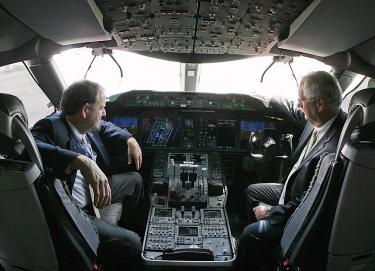
Boeing says 787 woes should be in the past now


Boeing says 787 woes should be in the past now

A top Boeing executive said the plane maker is frustrated with its latest 787 Dreamliner production glitch, but that it should not delay output goals.

Boeing vice president of development Mark Jenks said at a news conference yesterday in Singapore that the company has fixed a shimming problem discovered earlier this month on about 787 fuselages. Jenks said Boeing still plans to boost production from a current two to three 787s a month, to 10 of the planes a month by the end of next year. Jenks said the production mistake was “clearly frustrating and we’d rather it not happen.”

Boeing delivered its first Dreamliners last year to All Nippon Airways after several delays pushed back delivery by three years. ANA has so far received just two of the mid-sized, fuel-efficient jets, which is set to star at the Singapore Airshow this week where companies touting private jets and defense hardware to the Asian market will also be out in force.

Not to be outdone in Singapore, Airbus SAS — Boeing’s European rival — will display a large-scale model of its A350 XWB, which is still under development and is scheduled to enter into service by 2014. The A350 XWB is a mid-size, long-range plane which its makers tout as using 25 percent less fuel than similar sized aircraft in use today.
With Europe mired in a debt crisis and the US economic recovery still gaining traction, the world’s aircraft makers, major defense contractors and aerospace companies are looking at Asia’s robust markets, analysts said. Singaporean Second Minister for Trade and Industry S. Iswaran said Asia will account for 29 percent of global aircraft deliveries by 2026 and 32 percent of world air traffic in 2028.

However, with several airlines having already announced major purchases during the past 18 months, a key area of interest at the airshow — which starts tomorrow and runs through Sunday — will be the growing market for private jets in a region with expanding ranks of super-rich. “I’m expecting more focus on the private jet market,” said Shukor Yusof, a Singapore-based aviation analyst at Standard & Poor’s Equity Research.

“I think makers like Bombardier, Gulfstream and Embraer have more to offer in terms of the growing private jet business in mainland China and parts of Southeast Asia,” he said. Shukor said Asian tycoons are increasingly drawn to the convenience of a private jets over commercial flights, especially in a geographically fragmented region. “It’s more than just a status symbol, it’s more for practicality ... It’s probably more economical as well,” he said.

Defense companies will also make their presence felt at the biennial show.

India recently said it prefers the Rafale, made by French firm Dassault Group, over the Eurofighter after an intense bidding process for 126 fighter jets in a contract estimated to be worth US$12 billion. It is the world’s biggest single defense deal currently in process and underscores the region’s potential as a lucrative defense market.

“I think we can describe the picture in the Asia-Pacific market as an arms race,” said Guy Anderson, chief analyst at Jane’s Defence Industry. “We have a combination of growing national wealth, emerging national resources and the need to protect growth,” he said. “The rise of China remains a factor, but there are also numerous lower level regional rivalries ... Countries typically seek to achieve parity with their regional peers.”

For the first time, a Land Defense Expo will be launched in conjunction with the Singapore Airshow, organizers said. Consultancy Frost and Sullivan estimates the Asia-Pacific market for land defense systems should reach US$9.4 billion by 2016, up from US$5.4 billion in 2009.

The shift by regional armed forces toward weapons centered on high-tech networks, including the use of drones, is among the drivers for military modernization program, according to analysts.

Source:AP and AFP, SINGAPORE

1/14/2012

Aviation Safety: evolution of airplane interiors


Aviation Safety: evolution of airplane interiors

The accident fatality rate for jet airplanes has fallen dramatically during the last 50 years. This decrease is due in part to continuing efforts by airplane manufacturers and regulators to use information gained from accidents to develop safer, more survivable airplanes. 


A history of improving airplane interiors


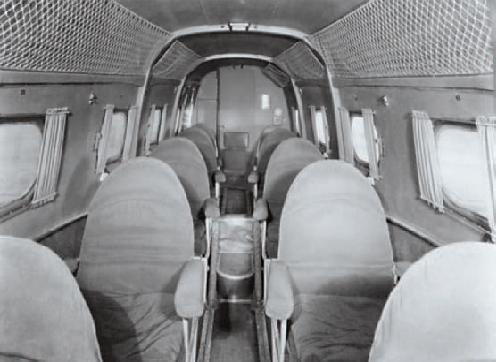
Since the first passenger airplane was introduced in the 1930s, airplane manufacturers have worked to make airplanes safer for the passengers and crew who fly in them. For example, Boeing has worked continuously to enhance the safety of its products and to lead the industry to higher levels of safety through global collaboration by working together, regulators, operators, and manufacturers can maximize safety by sharing knowledge and targeting safety efforts to address areas with the most risk. Some recent events highlight the safety of today’s passenger jet airplane interiors during takeoff and landing accidents.

Boeing 247, 1933
In December 2008, an airplane crashed while taking off, ending up on fire in a 40 foot deep ravine several hundred yards from the runway. There were no fatalities among the 115 passengers and crew, even though the metal fuselage had been breached by fire. 
In December 2009, an airplane carrying 154 passengers and crew overran the runway during a landing in heavy rain and broke apart. There were no fatalities. accidents involving the current generation of commercial airplanes are rare but offer important insights into advancements in the safety and crashworthiness of airplane design. These advancements reflect decades of innovation and targeted efforts to improve survivability in an airplane accident, especially during takeoffs and landings. 
Boeing 707, 1958
in august 2010, an airplane crashed while attempting to land during poor weather, breaking into three pieces on impact. There were 125 survivors among the 127 passengers and crew aboard the flight. The industry’s work on airplane safety and survivability of airplane interiors emphasizes three areas: surviving impact, surviving a fire, and evacuation.

Surviving Impact

Survivability is greatly influenced by seat design. The greater the ability of airplane seats to remain in place and absorb energy during an impact, the greater the likelihood of passenger survival. in addition, the seat back is designed to protect passengers behind the seat from head injury. Seat design. in the 1930s, passenger airplane seats could withstand a static force six times the force of gravity (6g). For commercial jet airplanes beginning in the 1950s, the 6g requirement was raised to 9g. Today’s seats are required to withstand a 16g dynamic force. a 16g seat is tested in a manner that simulates the loads that could be expected in an impactsurvivable accident. 

Boeing 787, 2001
Two separate dynamic tests are conducted to simulate two different accident scenarios: one in which the forces are predominantly in the vertical downward direction and one in which the forces are predominantly in the longitudinal forward direction. The highest load factor is in the forward direction at a force of 16g. Head injury protection. Where head contact with seats or other structure can occur, boeing provides protection so that the head impact does not exceed the Head Injury Criterion (HIC) established by the u.S. Federal aviation administration (FAA). HIC measures the likelihood of head injury resulting from an impact. compliance with the Hic limit is demonstrated during a dynamic sled test that includes a 50 percent male size test dummy, the seat, and any airplane structure that could be impacted by the occupant’s head. 

Surviving a fire

Floor proximity lighting under dark conditions
In 1985, the FAA developed a new test standard for large surface area panels, such as ceilings, walls, overhead bins, and partitions. The standard required that all commercial airplanes produced after august 20, 1988, utilize panels that exhibit reduced heat and smoke emissions, delaying the onset of a flashover (i.e., the simultaneous or near simultaneous ignition of all flammable material in an enclosed area). interiors are updated and refurbished many times during the life of an airplane. This results in interiors that incorporate these enhancements even in older airplanes. in addition, airplanes manufactured on or after august 20, 1990, must comply with definitive standards of a maximum peak heat release rate of 65 kilowatts per square meter, a maximum total heat release of 65 kilowatt minutes per square meter, and specific optical smoke density of 200 (i.e., the OSu 65/65/200 fire safety standard defined by Ohio State university). extensive fire protection systems are also part of every Boeing passenger airplane. These systems include the use of fire protective materials, smoke detection and fire extinguishing systems, and insulation blankets designed to resist burn through from a fuel fire next to the bottom half of the fuselage. 

Evacuating the Airplane


Floor proximity lighting under smoky conditions
The FAA requires that an airplane can be evacuated of all passengers in 90 seconds. Boeing airplane interiors include a number of features to facilitate this process. These features include floor proximity lighting and escape slides. Floor proximity lighting. When passengers evacuate after a crash, buoyant hot smoke and gases can fill the cabin down to near floor level, obscuring overhead lighting. evacuation is improved through the use of lights, reflectors, or other devices to mark the emergency escape path along the floor. The Faa determined that floor lighting could improve the evacuation rate by 20 percent under certain conditions. as a result, the U.S. commercial fleet was retrofitted with floor proximity lighting by 1986, marking the completion of a two year compliance schedule. The 777 was the first Boeing airplane to include floor proximity lighting in production models.


12/08/2011

ALITALIA CITYLINER

Alitalia CityLiner
Alitalia is updating its fleet and on Sept. 26th the airline received its first Embraer 190, for its regional division . The carrier ordered twenty E-Jets, five E190 and 15 E175, at a total cost of 400 million Euro, that will replace the current regional fleet of ten CRJ900 of Air One and six E170 are already in service on the Rome-Milan route and on the Rome-Vienna and Rome-Trieste, they are equipped with "step approach" technology to operate on shorts field such as Florence and LCA.

The regional segment f the company keeps name Alitalia CityLiner that was of Air One. The choice of the E-Jet was a difficult one, based on three parameters, the judgment of customers, the opinions of employees and the overall economic data, and they will be flown on more services than mere feeder routes. 
Strategic cooperation was established with the manufacturer, that provides advanced technology and very reliable delivery and post sale service. The E190 is configured with 100 single class seats of late generation, with 30_31 in. pitch, with an enhanced perception of space.


These airlines will be used both on point_to_point national and international routes, and as an alternate on non-peak hours flights on multi-frequency routes have a strong component of business flyers, who require different option of time, for which flexibility is necessary.
Thus the passengers who fly the E190 on non-peak hours will enjoy the same advanced technology and the same high level of comfort as on the Airbus A320 family.
The current bases of Alitalia CityLiner are Milan Linate and Rome Fiumicino, and Venice will soon be added. Turin and Naples are also of much interest.
For connections with airliners of less than 80 seats, Alitalia will keep relying on strategic partnerships with specialized companies that can manage aircraft with haigt cost. The current partners of Alitalia are Darwin Airline and Air Alps, but more partnerships are begin considered. Alitalia wants to operate on smaller airfield both with direct capacity and through partners. Small but distant airports, such a Crotone or Trieste, can be addressed with direct capacity. The carrier stresses  the interest  for smaller destinations, and the fact that with its new regional fleet, Alitalia is able to better connect the Italian territory, reaching those minors airports where it was absent in the pas.

11/14/2011

Jet-biofuel: is real bio?


Aviation biofuel is widely considered by the aviation industry to be one of the primary means by which the industry can reduce its carbon footprint.


Aviation biofuel is widely considered by the aviation industry to be one of the primary means by which the industry can reduce its carbon footprint. After a multi-year technical review from aircraft makers, engine manufacturers and oil companies, biofuels were approved for commercial use in July of 2011. Since then, multiple airlines have begun the use of biofuels on commercial flights . 
The International Air Transport Association (IATA) thinks a 6% share of sustainable 2nd generation biofuels is achievable by 2020 and Boeing supports a target of 1% of global aviation fuels by 2015. This is in support of the goals of the aviation industry reaching carbon neutral growth by 2020 and a 50% decrease in carbon emissions by 2050 .


The American Section of the International Association for Testing Materials (ASTM) approve the use of biofuels in July of 2011. This allows the airlines to fly passenger jets using derivatives of up to 50 percent biofuel made from feedstocks such as algae and wood chips. It will help carriers that account for 2 percent of global carbon dioxide emissions reduce pollution blamed for damaging the Earth’s atmosphere. Jet fuel is a mixture of a large number of different hydrocarbons. The range of their sizes is restricted by the requirements for the product, for example, freezing point or smoke point. Jet fuels are sometimes classified as kerosene or naphtha-type. Kerosene-type fuels include Jet A, Jet A-1, JP-5 and JP-8. Naphtha-type jet fuels, sometimes referred to as "wide-cut" jet fuel, include Jet B and JP-4. "Drop-in" biofuels are biofuels that are completely interchangeable with conventional fuels. Deriving "drop-in" jet fuel from bio-based sources is ASTM approved via two routes.


The first route is bio-SPK (Bio derived synthetic paraffinic Kerosene). Bio-SPK involves using oil which is extracted from plant sources like jatropha, algae, tallows, other waste oils, Babassu and camelina to produce bio-SPK by cracking and hydro-processing. The growing of algae to make jet fuel is a promising but still emerging technology. Algae fuel uses algae as its source of natural deposits. Harvested algae, like fossil fuel, release CO2 when burnt but unlike fossil fuel the CO2 is taken out of the atmosphere by the growing algae. Among algal fuels' attractive characteristics: they do not affect fresh water resources, can be produced using ocean and waste water, and are biodegradable and relatively harmless to the environment if spilled. Algae cost more per unit mass (as of 2010, food grade algae costs ~$5000/tonne), due to high capital and operating costs, yet are claimed to yield between 10 and 100 times more energy per unit area than other second-generation biofuel crops. One biofuels company has claimed that algae can produce more oil in an area the size of a two car garage than a football field of soybeans, because almost the entire algal organism can use sunlight to produce lipids, or oil. The United States Department of Energy estimates that if algae fuel replaced all the petroleum fuel in the United States, it would require 15,000 square miles (39,000 km2) which is only 0.42% of the U.S. map. This is less than 1⁄7 the area of corn harvested in the United States in 2000. However, these claims remain unrealized, commercially. According to the head of the Algal Biomass Organization algae fuel can reach price parity with oil in 2018 if granted production tax credits.


The second route is FT SPK (Fischer–Tropsch Synthetic Paraffinic Kerosene). This process involves processing solid biomass using pyrolysis to produce pyrolysis oil or gassification to produce a syngas which is then prossessed into FT SPK. Jet fuel from the Fischer–Tropsch process using natural gas and coal. Using natural gas as a feedstock, the ultra-clean, low sulfur fuel has been tested extensively by the U.S. Department of Energy and the U.S. Department of Transportation. The Air Force, which is the U.S. military's largest user of fuel, began exploring alternative fuel sources in 1999. On December 15, 2006, a B-52 took off from Edwards AFB, California for the first time powered solely by a 50–50 blend of JP-8 and FT fuel. The seven-hour flight test was considered a success. The goal of the flight test program is to qualify the fuel blend for fleet use on the service's B-52s, and then flight test and qualification on other aircraft. The test program concluded in 2007. This program is part of the Department of Defense Assured Fuel Initiative, an effort to develop secure domestic sources for the military energy needs. The Pentagon hopes to reduce its use of crude oil from foreign producers and obtain about half of its aviation fuel from alternative sources by 2016. With the B-52 now approved to use the FT blend, the C-17 Globemaster III, the B-1B, and eventually every airframe in its inventory to use the fuel by 2011. 


But just because the prefix “bio-” is tacked on the word “fuel” doesn't necessarily mean it creates less pollution. Conventional fossil fuels sometimes result in less overall carbon dioxide emissions than biofuels, points out a Massachusetts Institute of Technology study recently published online in the journal Environmental Science and Technology. As we know, many airlines, have started using blends of conventional jet fuel with fuel produced from plants. The biofuels can help the companies cut costs, but are they really better for the environment? Only if the plants they come from are grown in ecologically sensitive ways, says James Hileman, principal research engineer in the department of aeronautics and astronautics at MIT. "What we found was that technologies that look very promising could also result in high emissions, if done improperly," reports Hileman in an MIT press release. "You can't simply say a biofuel is good or bad ‚ it depends on how it's produced and processed, and that's part of the debate that hasn't been brought forward, says Hileman.

Hileman and MIT graduate students Russell Stratton and Hsin Min Wong examined the carbon dioxide produced during the life cycle of 14 fuel sources, including conventional petroleum-based jet fuel and "drop-in" biofuels: alternatives that can directly replace conventional fuels with little or no change to existing infrastructure or vehicles. Growing crops for jet fuel production often entails clearing forests or using machines that also burn fuel. Drilling for oil takes energy, too. Then the raw materials from both sources have to be transported and processed. "All those processes require energy," Hileman says, "and that ends up in the release of carbon dioxide.  People don't often think of coal-to-liquid fuel production as a green option, remarks Hileman. But "severe cases of land-use change could make coal-to-liquid fuels look green," he says. On the other hand, the study points out many forms of biofuel that are more environmentally sensitive and produce less pollution. Many of these truly “green” biofuels have common characteristics. They can grow on marginal lands and don't compete with food for prime fertile land, and they also create useful by-products. Hileman notes that many of these by-products can further reduce the overall carbon dioxide release from the biofuels.


For example, converting jatropha, a shrub that can grow in poor soils and dry areas, to biofuel also yields solid biomass: For every kilogram (2.2 pounds) of jatropha oil produced, 0.8 kilograms (1.8 pounds) of meal, 1.1 kilograms (2.4 pounds) of shells and 1.7 kilograms (3.7 pounds) of husks are created. These by-products can be used to improve soil, prevent erosion or feed animals, or be burned for heat or electricity production.

All in all, the transition to biofuels is a complicated subject. Hileman notes that this research is only one lens through which biofuels can be viewed. The costs involved and crop yields are important considerations as well.


10/15/2011


Are biofuel flights good news for the environment?

Airlines are starting to test biofuels on commercial routes, but 'sustainable' alternatives to kerosene remain controversial

Thomson Airways ran a biofuel-powered flight to the Canary Islands in October 2011.

Are biofuel flights really a good thing for the environment? How can we ever produce enough biofuels to power all flights? And won't they just consume precious land that could be used to grow food instead?


Last week saw the first commercial flight part-powered by biofuels take off from a UK airport. The TUI Travel Boeing 757 flight from Birmingham to Lanzarote took off and landed without any reported hitches. No technical modifications were made to the plane with one of its two engines powered with a 50/50 blend of conventional Jet A1 fuel and a "Hydroprocessed Esters and Fatty Acids" fuel produced from used cooking oil. TUI Travel said the fuel was supplied by a Dutch firm called SkyNRG and that the fuel was "approved as sustainable by WWF and the Roundtable on Sustainable Biofuels".

Judging by the increasing number of airlines around the world announcing such flights, and the likely imminent inclusion by the EU of aviation within its emissions trading scheme, it would appear that biofuels are likely to play a very significant role in the future of aviation. Aviation - unlike its ground-based transport alternatives - is currently totally reliant on fuels with the energy density offered by a fossil fuel such as kerosene. So a plug-and-play biofuel substitute for kerosene seems to be the only viable alternative at present. After all, we can't electrify our planes or power them by nuclear fission (or not in a way that would be accepted by paying passengers) - and most aircraft operating or purchased today have a predicted lifespan of at least 40 years.

But just how "sustainable" are the biofuels used in aircraft? And will they only act to force up food prices? To rely solely on second-hand cooking oil seems complete folly. But the aviation industry says it is only using this source of biofuel for demonstration purposes. TUI Travel, for example, says it is looking at using biofuels made from the "purge family of plants as well as from camelina". Meanwhile, Virgin has just announced a "breakthrough" in biofuel production with a fuel produced from "reprocessed waste gases from industrial steel production". And other aviation fuel developers say they are exploring algae-based biofuels.

Or, perhaps, all this talk of biofuels is a convenient distraction: with aviation said to be the fastest-growing source of greenhouse gas emissions, should we instead be concentrating on reducing the number of aircraft we send into the sky? Or is aviation so crucial to us all that it deserves a special status of exemption, as it has long enjoyed when it comes to fuel duty and VAT?

10/11/2011

Ryanair boss Michael O'Leary slams 'Heathwick' plan


Ryanair boss Michael O'Leary has hit out at proposals for a fast rail link between Heathrow and Gatwick airports.
The proposed link, which would follow the route of the M25 and mostly travel underground, would enable an airport hub dubbed "Heathwick" to be created.
The Department for Transport said at the weekend the plan, set to cost a reported £5 billion, was under consideration. But speaking at a press conference in central London, Mr O'Leary, chief executive of the Irish airline, said: "This Government has no policy on aviation whatsoever.
"They have no particular expertise in tunnelling. The last one they did was the Eurotunnel, which went bankrupt even before it opened."
Mr O'Leary, who was speaking at the launch of Ryanair's new Cash Passport scheme offering passengers savings on their flights, also blasted London Mayor Boris Johnson's idea for a new airport in the Thames estuary.

He said: "What you really need to do is build three additional runways: one at Gatwick, one at Stansted and one at Heathrow, which you could actually do for about £150 million to £200 million in each of the three airports, and you would finally have addressed the major problem here in the UK, which is the massive undercapacity of airports in the South East. "But wasting multi-billions building a bloody airport in the middle of the marshes somewhere where you then have got to build motorways to it, rail transport links - it's mad."

Yesterday Mr Johnson wrote in the Daily Telegraph: "I stick to my view that we need to think big, and the place where you could create a 24-hour hub airport that would leave our competitors standing and with the minimum disbenefits to human beings is in the Thames Estuary. "Such an airport would be an astonishing motor for growth in an area that has been left behind for too long, and it would entrench London's lead, for the next 50 years, as the economic powerhouse of Europe."

Commenting on the Heathrow-Gatwick link plan at the weekend the Department for Transport said it was not Government policy but was being considered. He said: "The Government is committed to developing a new policy framework for aviation which supports economic growth while addressing the environmental impacts of flying. We plan to publish a draft aviation policy for consultation in the spring.
"As part of our work on this we are seeking views on the key issues which need to be addressed, including the importance of a UK hub airport and whether it might be possible to create a 'virtual hub' by improving connectivity between existing airports. "This proposal will form a useful contribution to the debate and will be considered alongside all other responses."

(SOURCE: THE INDEPENDENT)

Sukhoi Superjet 100 of Armavia: 1000 hours in the air


The Sukhoi Superjet 100 (SSJ100) of Armavia scored 1,000 flight hours in revenue flights. The milestone was reached during the SSJ100 flight U8-151 performed on route Yerevan – Amsterdam on October 9 2011. Since entering commercial service on April 21, 2011 the SSJ100 of Armavia carried more than 21,000 passengers and covered distance more than 650,000 kilometers. SSJ100 of Armavia performs flights from Yerevan to 27 airports in Russia, Ukraine, Georgia, Western and South Europe and Middle East. Most flights were performed at 35000 – 39000ft altitude, at the speed of 0.78-0.8 M. 

The highest daily utilization reached 16.5 flight hours while the biggest distance exceeded 4,000 kilometers on route Yerevan – Madrid. Such perfect result of the initial phase of the commercial operation of the brand new Sukhoi Superjet 100 aircraft was achieved due to the efficient activity of Armavia’s flight and technician staff and proper support from Sukhoi Civil Aircraft and SuperJet International. “This stage showed that the SSJ100 is competitive and has a great resource for excellence. It can make the aircraft very attractive for customers and operators”, said the owner of Armavia Mikhail Bagdasarov. “We sincerely thank Armavia for great and efficient efforts on the entry of our first production aircraft in commercial operation. The SSJ100 confirmed to be suitable both to regional and to short-haul routes. We are very pleased that crews and passengers of Armavia like our aircraft. 

We believe that our fruitful relations with Armavia will be successfully strengthened and will continue to provide the airline with comprehensive support jointly with our partner company SuperJet International”, noted Vladimir Prisyazhnyuk, President of JSC “Sukhoi Civil Aircraft”. Sukhoi Superjet 100 (SSJ100) is a 100 seat regional jet designed, developed and built by Sukhoi Civil Aircraft Company (SCAC), in partnership with Alenia Aeronautica. On May 19th 2008 SSJ100 successfully accomplished its first flight. The Sukhoi Superjet 100 cruises at a Maximum Operating Speed of Mach 0.81 and 40.000 feet. It takes off from a 1.731 meters runway in the basic range and 2.052 meters in the long range. The operating range for the basic version is 3.048 km and 4.578 km for the long range version. 

In February 2011, the SSJ100 obtained the Type Certificate by the Russian Certification Authority IAC AR. The EASA certification is expected to follow in 2011. On April 19th 2011 first production SSJ100 was delivered to Armavia airlines (Armenia). There are currently three SSJ100s in service with Armavia and Aeroflot.

(Source: Superjet)


American Airlines' lesson: Being big isn't enough


Another dip in the economy means trouble for airlines, especially for AMR Corp., the parent of American Airlines. Like Alaska Air Group, AMR went through the tough times after 9/11 without going through bankruptcy reorganization. But the resemblance ends there. Alaska shares are trading above $60, while AMR stood at $2.73 this morning. For weeks, fears have grown that the carrier will be forced into Chapter 11.

American, once one of the nation's most innovative and service-oriented airlines, faces high labor costs, more than $12 billion in outstanding debt and big unfunded pension costs (why weren't those highly compensated executives fulfilling their duty and funding the pensions...?). Its fleet is aging, hence the recent 460-jet order split between Boeing and Airbus.

Unions have concessions but it hasn't been enough to save the airline from repeated losses and now speculation about its future. The conventional wisdom, of course, is another merger, perhaps with US Airways. That's the last thing AMR needs.

Recall that the 2001 merger with TWA was supposed to make American stronger. It didn't work. Thousands of jobs were lost to "make the numbers work," including, based on calculations at the time, some 12,000 jobs and more than $600 million in annual wages in Missouri, where TWA had its key St. Louis hub. With or without the event of 9/11, history shows that airline mergers, like most big deals, don't deliver beyond quick gratification. They do add debt, eliminate competition (even if TWA had filed for bankruptcy, it might have emerged as a healthy competitor, or been replaced by a new one) and hurt customer choices. No wonder: Management is too distracted by merging rather than focused on serving customers.

(Via The Seattle Times)

10/10/2011


German air traffic controllers to stage walkout  this week


Germany's air traffic controllers' union reject employer's offer,and  decided Monday to stage a walkout this week which could severely disrupt flights across Europe.

The GdF union said its board has rejected the management's latest offer. However, it added that it is still prepared to comply with a request from the federal government and meet once again for talks with an arbiter.

The state-run DFS air traffic control agency had no immediate comment on the strike announcement.

The union said over the weekend that a strike could take place as early as Wednesday. A strike must be announced with 24 hours notice, and the union did not immediately elaborate whether it was planning short walkouts in a few regions, or a full-scale strike across Germany.

The DFS agency sent the dispute over pay and working conditions to arbitration in early August, but the union partly rejected the outcome a month later.
New negotiations based on the arbitration's result broke down late Friday. Both sides have accepted the arbiter's compromise of a general salary raise of 5.2 percent, but the union wants more people to be promoted faster.

The DFS agency has about 6,000 employees, coordinating about 10,000 flights a day, making Germany's skies Europe's busiest.

(VIA ASSOCIATED PRESS)


What Brands Can Learn From Pan Am-The Airline And The Show


Bond, James Bond, would only fly on Pan Am. That’s what a cool airline it was. Once the world’s leading airline, with scores of innovations to its credit, it’s been interesting to watch the new ABC drama, “Pan Am” and ponder the recipe that made this airline’s experience so magical. Or more specifically, from my marketer’s point of view, what made Pan Am such an incredibly strong brand.


For those too young to remember, flying used to be fun and, at times, downright glamorous. In the movie “Catch Me If You Can,” Leonardo DiCaprio plays Frank Abagnale, a fast-talking teen who cons his way into a number of professional situations – doctor, lawyer, and a pilot for Pan Am. The kid is after excitement and, at the time, the airline industry was exciting. And, Pan Am, with its stellar fleet of “Clipper” ships, its international routes, it’s stewardesses in black high heels and tailored uniforms, and it’s dashing pilots, was the most exciting of all. It was, in fact, the very symbol of the romance of flight. The people who worked for the airline loved what they did. They had a passion for flying, and their passion was infectious. Service was a high priority. Passengers were well cared for. And, yes, these passengers actually got dressed up to fly. It was that special.

Then, it became not so special. The airline business began to get big and complicated and messy for a lot of reasons, not the least of which were deregulation and the high price of oil. Dollars were squeezed out of the system. Pennies were squeezed out of the system, and passengers started to get squeezed. Management lost sight of the fact that keeping customers happy was critical to success and the people who worked for the airlines, in return, began to lose their passion for flying and the industry in general. And therein is the answer, to the branding question, anyway.

To put it bluntly, a brand is as a brand does. And the most critical aspect of what a service brand does is, well, duh, provide service. To a large part, the success of airlines, hotels and restaurants, retailers, and other service-oriented categories is dependent on the people on the front lines. People are the branding applications, so to speak, that create the relevantly differentiated experience. They’re the points of touch most critical to bringing the brand’s purpose to life. In the case Pan Am, it wasn’t the seats in the planes, the advertising, or even the iconic blue logo that made it what it was. These were relative commodities. It was the people and their love of what they did for a living. More than this, as is true of every super service brand, management empowered those on the front lines to do the right thing to preserve customer satisfaction. While I know it was part of the drama, on the first episode of “Pan Am,” a middle manager arranges to have a helicopter meet a flight crew’s purser on the top of the (where else?) Pan Am building in New York City when it becomes apparent this was the only way she’d be able to get to her flight on time. No red tape. No questions asked. Her job was to ensure the well being of those on board the aircraft and whatever it took to solve the problem was the modus operandi.

Pan Am understood – until it didn’t – that its employees were the magic ingredient that made it as good as it was. The people who worked for Pan Am delivered best in class because they understood what the brand stood for in the minds of consumers and they had a genuine passion for bringing best in class to life. When they joined the company they knew what they were signing up for. It was when Pan Am lost sight of the fact that its employees were what differentiated its brand from every other in the field that it lost its way. For companies in search of a lesson learned, it’s tough to make a brand fly when you’re reduced to competing on commodities. While, “Pan Am,” the new television show is, of course, all about conjuring up only the glamour that was air travel in the nineteen sixties, it does hit on something real: A brand is as a brand does. And, the real Pan Am did it up swell.

Royal Brunei Outlines New Short-Haul Strategy

Royal Brunei Airlines  is adding Airbus A320s to its fleet next year and has confirmed that its new business strategy is to focus on short-haul rather than long-haul operations.


The carrier “is planning to add at least one extra A320 to the short-haul fleet in March-May 2012 to ensure the airline can offer a more consistent schedule and level of service on the regional network,” it says. RBA has no A320s on order, which means it is likely to be in the market to lease the aircraft.

Royal Brunei also says it remains committed to taking delivery of Boeing 787s, the first of which will come in 2013. The carrier has five 787-8s on order, according to the Ascend database.

The airline also has six Boeing 777s, which are leased from Singapore Airlines (SIA), but it no longer needs so many 777s because from Oct. 30, it will stop flying to Auckland, Brisbane, Perth and Ho Chi Minh City.
Executives at the airline says they are trying to persuade SIA to let RBA break the lease and return some of the 777s. The airline says extensive research it conducted earlier this year shows it “must realign its goals and focus once again on becoming a regional hub with strategic connectivity—a return to its roots. This means focusing on regional traffic and maintaining only the long-haul routes which are consistent with the airline’s long-term objectives.”

Royal Brunei says it is abandoning some long-haul routes because the research showed that only about 9% of the traffic on long-haul routes originates in Brunei or ends in Brunei. “This 9% are the passengers that contribute to Brunei’s local economy—the rest simply transit Brunei on their way somewhere else and offer little in the way of economic activity,” RBA says.
“In these circumstances, it has become impossible to justify the continuation of the route network in its entirety, where RBA is effectively providing subsidies to over 90% of the traffic, while creating little or no economic value either for the airline or the country.”

By comparison, about 75% of all passengers on its regional routes are based in or are visiting Brunei. “It is clear why RBA must focus on the regional market,” says RBA. “To continue to serve the routes that have been suspended, would cost RBA and Brunei far more than the economic benefit the airline or country would receive in return for keeping these routes open.”

The carrier admits there are arguments that the long-haul services should continue because the belly-hold space on the aircraft is important for transporting goods to and from Brunei.
But Royal Brunei says there is no rule that says freight requires a nonstop service. It says, “Daily connections via regional hubs should be more than enough to supply Brunei with all of the goods we currently enjoy.”

Air China Announced to Join Sustainable Aviation Fuel Users Group (SAFUG )


Recently, Air China officially announced to become a member of Sustainable Aviation Fuel Users Group (SAFUG). Being the first Chinese airline of the Group, Air China will be in line with other members to support the commercial use of lower carbon renewable fuels, derived from environmentally and socially sustainable sources, to achieve a broader aim of achieving carbon-neutral growth across the industry. 

Established in 2008, SAFUG is a world-leading working group on aviation biofuel, dedicated to support the development and commercialization of sustainable and renewable aviation fuel. By joining the Group, Air China will participate in the industry-leading study on aviation biofuel, and share its existing experience in the aviation biofuel flight test. 

In recent years, Air China consistently pursues sustainable development, and considers environmental protection as an important social responsibility. The Company decisions, day-to-day operations and other relevant activities are guided on the principles of energy efficiency and emission reduction. Furthermore, Air China also endeavors to minimize its environmental impact by adopting new aircraft and flight technologies. In early 2011, Air China published the Corporate Environmental Policy, which commits to pursue effective environmental management throughout all business practices, and actively participate in industrial and international cooperation, to encourage the relevant low-carbon studies and solutions of aviation industry, such as aviation biofuel. 

To fulfill this commitment, Air China will work jointly with Boeing, Petro China, UOP and other key stakeholders to implement the first biofuel flight in China late this year. Significantly, the biofuel is produced from locally grown plants. A transpacific biofuel flight is also expected to be implemented afterwards. These demonstration flights are considered to assist in generating excitement and support from corporate, regulatory and relevant entities, and will be a great path to future development. 
Air China’s efforts to enhance its participation in aviation biofuel development is an important driver towards a sustainable and clean future.

10/09/2011


Significant’ Cracks Found on Boeing 767 Prompt FAA to Expand Jet Checks


United Continental Holdings, Delta Air Lines, American Airlines and other U.S. carriers may need to inspect their Boeing 767s twice as often after one operator found “significant crack sizes” had developed sooner than expected.
Airlines should inspect the twin-engine jets after 2,000 flight cycles or 6,000 flight hours, double the current requirement, the Federal Aviation Administration said in a proposal to be published in the Federal Register next week. The rule may affect 417 planes in the U.S., the agency estimated.

The FAA is proposing heightened scrutiny of the wing skin after cracks as large as a half-inch (1.3 centimeters) were found on either side of a fastener hole on a plane that had 18,900 flight cycles and 89,500 total flight hours. The 767 is a wide-body plane typically used on international flights.
“We support the rule proposed by FAA,” Julie O’Donnell, a spokeswoman for Chicago-based Boeing, wrote in an e-mailed message. The change “essentially would mandate the recommendations that Boeing first made to operators in a service bulletin in 2009 and revised in March 2011.”
Delta is one of the biggest operators of 767s, with 92 of the jets, some of which are an average of 19.7 years old, according to the Atlanta-based carrier’s most recent annual report. Fort Worth, Texas-based American has 73 of the planes, some of them 24 years old; Chicago-based United has 61 of the planes, some 18.3 years old.

Delta, United Continental
Delta wasn’t the unnamed airline whose 767 had the cracks, spokeswoman Ashley Black wrote in an e-mail. The company is in compliance with current FAA inspection requirements and will follow any changes that the agency makes, she said.
United Continental also complies with FAA directives and will continue to do so, said Megan McCarthy, a spokeswoman for the carrier.
“We’re watching it closely,” she said.
Spokesmen for the other carriers didn’t immediately comment on the proposed regulation.
Earlier this year, Boeing called for more inspections on older 737 narrow-body jets after a Southwest Airlines plane split open midflight, prompting an emergency landing. Two people were injured.
Metal fatigue cracks on the so-called 737 Classic weren’t forecast to occur until “much later,” after 60,000 cycles of takeoffs and landings, Boeing said in April. The Southwest jet that ripped open on an April 1 flight had flown 39,781 cycles.
Investigators said the Southwest plane’s fissure was caused by weakened fasteners in joints along the crown of the jet, and Dallas-based Southwest later found cracks on five more 737s. Boeing developed repair plans for the aircraft.

(Via BLOOMBERG)

UK Airlines denounce airports’ ‘virtual hub’

Ever since the coalition government ruled out allowing new runways at Heathrow, Gatwick or Stansted airports, ministers have been accused by the aviation industry of lacking a credible policy to deal with rising long-term demand for air travel.
In theory, the ambitious proposal to integrate Heathrow and Gatwick through a high-speed rail link could form the solution, but the industry has quickly denounced the idea.
More

Ministers have been told by business that a new aviation policy was badly needed as part of efforts to kick-start the flagging economy. A report published last month said the UK was at serious risk of missing out on trade with emerging markets worth £14bn during the next decade because Heathrow was operating at full capacity and could not expand.
These findings about the capacity crunch in the south-east explain why ministers are coming under pressure to speed up their policymaking. They previously promised an aviation framework by 2013.
Ministers may now be focusing their minds, but on Friday airlines and airport operators lined up to express grave misgivings about the interest in creating a “virtual hub” between Heathrow and Gatwick.

British Airways said linking Heathrow and Gatwick “does absolutely nothing to address the ever more pressing issue of the south-east’s need to have more airport capacity in order for the UK to remain globally competitive”.
BAA, Heathrow’s owner, said the idea “faces insurmountable technical, operational, political and financial challenges, and would take many years to deliver”. A rail industry executive, who declined to be named, said it would be difficult to build a high-speed network between Heathrow and Gatwick.

The government is holding to its view that it will not allow the construction of more runways at Heathrow, Gatwick or Stansted.
However, ministers think additional airport capacity may be found by linking Heathrow and Gatwick. Following the construction of a high-speed rail link between the two airports, the idea would be for Gatwick to focus on short and medium haul flights to and from Europe.
Some of these Gatwick flights could then provide important feeder traffic to Heathrow, which would focus on long-haul flights.

Gatwick has some room to accommodate extra flights because it is operating at 80 per cent capacity. In theory, more capacity could be found if Ryanair and EasyJet, the low-cost airlines, ended their operations at Gatwick and concentrated on Stansted and other airports, such as Luton.
Ryanair and EasyJet might choose to sell their take off and landing slots at Gatwick if they increased in value because of a high-speed rail link with Heathrow.

But Michael O’Leary, Ryanair’s chief executive, said there was “no way of moving the budget airlines out of Gatwick”. He added: “There won’t be a high-speed rail link between Heathrow and Gatwick in my lifetime. The cost of it would be prohibitive.”
EasyJet, which dismissed the idea of linking Heathrow and Gatwick, said: “EasyJet will fight any attempt to force us out of Gatwick all the way.”

(Via FINANCIAL TIMES)


Airbus: South Pacific Carriers Will Need 736 Aircraft Worth $98 Billion
Demand Seen For Larger, More Efficient Aircraft Over The Next 20 Years


According to Airbus’ latest Global Market Forecast, between 2011 and 2030, carriers in Australia, New Zealand and the Pacific Islands region will require 736 new passenger and freighter aircraft (above 100 seats) valued at $98 billion. The region’s close links to emerging economies are the main contributor to traffic growth with business and tourism set to grow steadily. Urbanization and a doubling in the number of mega cities from two to five in 2030 and a bigger middle class base will also spur traffic growth. Low Cost Carriers will continue to expand and their market share of traffic between the region and Asia is forecast to increase to some 35 per cent by 2030. 

Airbus forecasts a regional growth rate of 4.8 per cent per year up to 2030, matching the world average, but outstripping all other developed aviation markets such as North America (2.5 per cent, domestic) and Western Europe (3.5 per cent, inter regional).
The region’s requirement for 736 new passenger and freighter aircraft includes 468 single aisles, 211 twin aisles, and 57 very large aircraft (VLA). Of these, 731 will be passenger aircraft, broken down as some 380 for growth, and 349 for replacing older models with more fuel efficient ones. In 20 years, the region’s passenger fleet will almost double from some 400 aircraft today to over 780 by 2030.

John Leahy, Chief Operating Officer Customers says, “More people want to fly. Load-factors will continue to rise. Add to this higher fuel costs and infrastructure which cannot keep pace with growing demand, then larger more fuel efficient aircraft are the only sensible choice, and this is confirmed by our latest Global Market Forecast.The long term market appetite for high capacity, high productivity aircraft like the A380 remains healthy".

Globally, in the next 20 years, Asia Pacific including China and India will be at the center of the world’s strongest demand for aircraft (34 per cent) and by 2030, the largest share of traffic (33 per cent). This concentration of demand, together with its historical links to Western markets will drive business and tourism in the region. Traffic growth between Australia, New Zealand and the Pacific Island’s region and China (6.2 per cent), India (5.6 per cent) and the rest of Asia (5.7 per cent) is forecast to be significantly quicker than the world average 4.8 per cent.