5/03/2012

The battle of wing extensions for new single-aisle


"Dual feather winglet."
This is the new solution proposed by Boeing for the new 737MAX. The winglet on the 737 MAX will have two tips, one bending up, the other down.

The Boeing Co. has designed a new winglet for the 737 MAX to cut fuel costs.The company previously had estimated the MAX would offer fuel savings of 10 percent to 12 percent compared to the current 737, with this solution the additional saving is 1.5 percent on fuel.
"Incorporating this advanced technology into the 737 MAX design will give our customers even more advantage in today's volatile fuel-price environment," Jim Albaugh, president of Boeing Commercial Airplanes, said in the statement. Boeing launched the upgraded 737 MAX last August to compete with the A320 new engine option, or A320neo, which rival Airbus announced in late 2010. Both re-engined single-aisle jets are expected to offer improved fuel savings.
High Resolution Image (click for larger) of what Boeing expects the winglet for the new 737 MAX will look like. Image from Boeing.  "The concept is more efficient than any other wing-tip device in the single-aisle market because the effective wing span increase is uniquely balanced between the upper and lower parts of the winglet," said Michael Teal, chief project engineer for the  737 MAX. Boeing said the dual feather winglet was validated during wind tunnel testing of the 737 MAX. The new winglet fits existing airport gate constraints "while providing more effective span, thereby reducing drag," the company said. "We have assessed the risk and understand how to leverage this new technology on the MAX within our current schedule," said Teal. "This puts us on track to deliver substantial additional fuel savings to our customers in 2017." The company estimates the 737 MAX will use 18 percent less fuel than the current Airbus A320.
In 2009, Airbus announced it would offer fuel-saving wing tips that the company calls "sharklets" as an option on the A320. The neo adds winglets — Airbus calls them "sharklets" — to the current A320 design, but they are very similar to the upward swooping winglets on today's 737s.
Because the 737 already has winglets, Airbus executives have argued that the MAX cannot gain the extra 3.5 percent fuel-burn improvement the European plane-maker will gain by adding winglets to the neo. Wednesday's announcement of a radical new Boeing winglet design undercuts that argument. Boeing had previously claimed a 5 percent fuel-burn advantage over the neo. Spokeswoman Lauren Penning said the new MAX wingtip's incremental fuel-burn advantage adds up to a further 1.5 percent advantage compared with the neo. Airbus hotly disputes Boeing's figures. Before news of the "dual feather" winglet, Airbus had been claiming the neo would burn 8 to 11 percent less fuel than the MAX, depending on which sub-models are compared.
Airbus hotly disputes Boeing's figures. Before news of the "dual feather" winglet, Airbus had been claiming the neo would burn 8 to 11 percent less fuel than the MAX, depending on which sub-models are compared.
Airbus spokeswoman Mary Anne Greczyn said Wednesday the company's engineers looked at the option of a split-tip winglet for the neo but decided on the "sharklet" design. Separately, Boeing revealed that the MAX will require a slight bump in the door of the nose landing gear. That's because the nose gear must be extended by 8 inches, compared with the current 737, to lift the wing and allow sufficient ground clearance for the new, bigger CFM engines. To fit the longer nose gear into the wheel well without major structural changes, Boeing is shaping the landing-gear door so that it bulges outward to accommodate the tires. That will add some drag, but Teal said the impact is "negligible." The projected fuel-burn improvement takes into account all the changes, negative and positive.Airbus has produced the first new-build A320 with Sharklets. Depicted here at its roll-out in Toulouse, MSN 5098 will be one of several A320 Family aircraft in the certification flight-test campaign starting in May this year and lasting around 600 flight hours. These Sharklet tests follow the successful ‘early flight-test’ campaign with Airbus’ A320 MSN 001 test aircraft.
In a conference call with journalists, Michael Teal, chief project engineer for the 737 MAX, called the concept "the most advanced wingtip technology in the single-aisle market." The design is innovative. No commercial airplanes in service today have anything similar, though the concept resembles a split-tip winglet design Seattle-based Aviation Partners is flight testing. Winglets in general add extra wing surface without extending the overall wing span. They increase the wing's lift while their shape reduces the drag caused by air vortices at the wingtip. Teal said the split ends of the new wingtip maximize the aerodynamic gain without adding as much weight as a longer, single winglet would.
The overall MAX wing span will be just a few inches longer than the current 737. Teal said the upper feather of the new winglet is close to the size of today's 737 winglets, which are nearly 8 feet tall. The lower feather will be shorter to ensure sufficient ground clearance. Boeing aerodynamicists came up with the design using computer simulations, then tested it in two advanced wind tunnels, Teal said.
He said the new winglets can be incorporated into the overall design within the previously announced schedule, which will see the MAX enter service in 2017. Final details for the jet's design and manufacturing will be pinned down next year. Last fall, at a Las Vegas business-jet conference, a somewhat similar design called the Blended Split-Tip Scimitar Winglet was showcased by Aviation Partners, which pioneered winglet technology and works with Boeing in a joint venture that produces winglets for the 737.


2/23/2012

Boeing 787-10 or 777-8x: decision Likely This Year


A potential double-stretched 787-10 variant depends more on what Boeing decides to do with the 777 more than anything else.


Not for the first time, talk about a double-stretched 787 has entered the fray only this time, Boeing’s decision to establish a dedicated development team for the 777 puts the decision making into a rather grey area. Some of this is compounded by the ever-growing uncertainty over the rival Airbus A350-1000, which thus far is failing to make the grade on paper (or sales) against the 777-300ER.

There is equally the possibility that Boeing could do both moves and squeeze the big Airbus jet – it is a poor selling model in contrast to other 777, A350 and 787 variants. For whatever its worth, there’s more chance of a 787-10 and/or enhanced 777 emerging than there is of a so-called 150 seat CSeries.


Boeing hopes to make a decision this year on the 787-10 and aims to ensure that this larger-capacity 787 avoids cannibalizing sales of the 777, another family of Boeing aircraft that also may be getting new models, the 777-8X and 777-9X. While the 777 looks more than likely to benefit from a revamp rather than a full overhaul, this is paced more with the fact that the larger A350-1000 is still undefined and program sources attribute significant issues with the baseline A350-900 that have to be ironed out first before a stretch can happen, much less meet the advertised specifications Airbus has listed. 

Boeing is loathe to grow the 787 into 777 territory – a stretch too far, and you end up with a useless airplane like the A340-600 which trades passengers and payload for range and is saddled with higher costs.
A second stretch of the 787 would also raise engine thrust issues, affecting performance. As Boeing studies its options with 777, the company feels that a lower cost approach to improving that would be far more beneficial to countering the perceived angst any A350-1000 could cause.

Boeing Commercial Airplanes CEO Jim Albaugh said, “We will do the 787-10 by all likelihood. We’re now working through design concepts. Assuming the customer interest is there, later this year [a decision will be made], and we will have something to offer toward the end of the year.” He says the 787-10 will have a shorter range than the -9 but will be able to carry 40 more passengers, so “the economics are very good.”
The fact that the 787-10 is a stretch of the 787-9 means it will be in the realm of the 777 in terms of seating capacity. Albaugh, however, suggests otherwise. “We think we’ve got a good separation between the models. There’s 15% separation between the models. We’ve spread the sizing between them, so we don’t cannibalize any one aircraft.”

There have been some reports about a 777-8LX model, which promises more range, but Albaugh is dismissive. “I’ve seen something on a chart mentioning that, but I am focused on the 777-9X and 777-8X,” he says, referring to the new stretched version of the 777-300ER and 777-200, respectively. Albaugh was speaking to Aviation Week in Singapore yesterday during a media roundtable.

He says the 777-8X and 777-9X are hugely important to the company. Boeing sold 200 777s last year, and the aircraft is unbeatable in terms of efficiency, asserts Albaugh. But he also says Boeing is mindful of the fact that Airbus is planning the A350-1000, and declines to disclose details on the 777-9X, except to say “it will be a significant improvement over the 777-300ER.”

As for the 737 MAX, Albaugh says, “I hope we can have a couple of thousand orders before we deliver the first aircraft.” Boeing already has secured firm orders for the 737-8 and 737-9. Albaugh says it also has secured a 737-7 customer, but has yet to disclose who that is.

Albaugh declines to say when the 737 MAX specifications will be locked, but asserts they are already effectively firmed up because Boeing is giving MAX customers guarantees when it comes to the specs. He also says, “I don’t want to over-promise and under-deliver. I want to ensure that it is on spec and delivered on time.” Boeing has learned from the lessons of the 787 program, he adds.

Boeing has started delivering 787-8s, but has had to do some post-production fixes to the aircraft in response to concerns about delamination.

2/13/2012

Boeing says 787 woes should be in the past now


Boeing says 787 woes should be in the past now

A top Boeing executive said the plane maker is frustrated with its latest 787 Dreamliner production glitch, but that it should not delay output goals.

Boeing vice president of development Mark Jenks said at a news conference yesterday in Singapore that the company has fixed a shimming problem discovered earlier this month on about 787 fuselages. Jenks said Boeing still plans to boost production from a current two to three 787s a month, to 10 of the planes a month by the end of next year. Jenks said the production mistake was “clearly frustrating and we’d rather it not happen.”

Boeing delivered its first Dreamliners last year to All Nippon Airways after several delays pushed back delivery by three years. ANA has so far received just two of the mid-sized, fuel-efficient jets, which is set to star at the Singapore Airshow this week where companies touting private jets and defense hardware to the Asian market will also be out in force.

Not to be outdone in Singapore, Airbus SAS — Boeing’s European rival — will display a large-scale model of its A350 XWB, which is still under development and is scheduled to enter into service by 2014. The A350 XWB is a mid-size, long-range plane which its makers tout as using 25 percent less fuel than similar sized aircraft in use today.
With Europe mired in a debt crisis and the US economic recovery still gaining traction, the world’s aircraft makers, major defense contractors and aerospace companies are looking at Asia’s robust markets, analysts said. Singaporean Second Minister for Trade and Industry S. Iswaran said Asia will account for 29 percent of global aircraft deliveries by 2026 and 32 percent of world air traffic in 2028.

However, with several airlines having already announced major purchases during the past 18 months, a key area of interest at the airshow — which starts tomorrow and runs through Sunday — will be the growing market for private jets in a region with expanding ranks of super-rich. “I’m expecting more focus on the private jet market,” said Shukor Yusof, a Singapore-based aviation analyst at Standard & Poor’s Equity Research.

“I think makers like Bombardier, Gulfstream and Embraer have more to offer in terms of the growing private jet business in mainland China and parts of Southeast Asia,” he said. Shukor said Asian tycoons are increasingly drawn to the convenience of a private jets over commercial flights, especially in a geographically fragmented region. “It’s more than just a status symbol, it’s more for practicality ... It’s probably more economical as well,” he said.

Defense companies will also make their presence felt at the biennial show.

India recently said it prefers the Rafale, made by French firm Dassault Group, over the Eurofighter after an intense bidding process for 126 fighter jets in a contract estimated to be worth US$12 billion. It is the world’s biggest single defense deal currently in process and underscores the region’s potential as a lucrative defense market.

“I think we can describe the picture in the Asia-Pacific market as an arms race,” said Guy Anderson, chief analyst at Jane’s Defence Industry. “We have a combination of growing national wealth, emerging national resources and the need to protect growth,” he said. “The rise of China remains a factor, but there are also numerous lower level regional rivalries ... Countries typically seek to achieve parity with their regional peers.”

For the first time, a Land Defense Expo will be launched in conjunction with the Singapore Airshow, organizers said. Consultancy Frost and Sullivan estimates the Asia-Pacific market for land defense systems should reach US$9.4 billion by 2016, up from US$5.4 billion in 2009.

The shift by regional armed forces toward weapons centered on high-tech networks, including the use of drones, is among the drivers for military modernization program, according to analysts.

Source:AP and AFP, SINGAPORE

2/08/2012

The entire global fleet of Airbus A380 superjumbo jets are to be checked for cracks inside the wings.


The European Aviation Safety Agency (EASA) last month ordered “a detailed visual inspection”. The checks are to be extended to the entire fleet of 68 planes flying with seven different airlines, it was announced yesterday.

The EASA say they are working with Airbus on a “long-term fix” for the problem that should be ready by the summer. The decision to extend the order was made after the first set of results of inspections, but EASA say they don’t have details on how many cracks have been found in total. The checks are on the aircraft’s “wing rib feet” - the metal brackets that connect the wing’s ribs to its skin. (Graphic showing the location of the wing rib brackets in an A380 superjumbo, which are at the centre of concerns over cracking. Source: Airbus) 

A380 wing structure

The EASA’s original order came when Airbus said it had found new cracks on the brackets inside the wings of two superjumbos after inspections launched following a 2010 incident in which a Qantas A380’s engine disintegrated in flight. The agency gave airlines between four days and six weeks from January 24 to carry out checks on the initial batch of superjumbos, whose future customers include British Airways and Virgin Atlantic. Under the extended order, planes that have flown fewer than 1,300 takeoff and landing cycles will have to be checked before reaching that point, and planes that have flown more will have to be inspected within three weeks. 

Airbus said it has developed repair kits for the problem, which are currently being installed, and that the aircraft remained safe to fly. “These brackets are located on wing ribs which are not main load bearing structure, and, thus, the safe operation of the aircraft is not affected. “Nearly 4,000 such brackets are used on the A380 to join the wing-skin to the ribs. Only a handful of brackets per aircraft have been found to have been affected.” EADS said.


Still, EASA in its directive said that "this condition, if not detected and corrected, could potentially affect the structural integrity of the airplane."The airworthiness directive last month applied to the 20 planes that have flown the most. EASA spokesman Dominique Fouda said the updated directive extends the checks to the entire fleet of 68, currently flying with seven different airlines."In parallel, we are working with Airbus on a long-term fix that should be ready by the summer," He said the decision to extend the order was made "given the first results" of the inspections, but said he didn't have details on how many cracks have been found in total. EASA's original Jan. 20 order came after Airbus said it had found new cracks on the brackets inside the wings of two superjumbos after inspections launched following a 2010 incident in which a Qantas A380's engine disintegrated in flight. 

The agency gave airlines between four days and six weeks from Jan. 24 to carry out checks on the initial batch of planes. Earlier Wednesday, Australia's Qantas Airways said it was temporarily grounding one of its A380s after discovering dozens of hairline cracks in its wings. It said, however, that the cracks were of a different type from those that prompted EASA's Jan. 20 directive

2/07/2012

Boeing and Korean Air today celebrated delivery of the airline’s first 747-8 and 777 Freighters.

The Boeing Co. delivered two aircraft to Korean Air on Monday in a ceremony at the Future of Flight Aviation Center near Mukilteo. Korean Air will be the first carrier to operate both 777 and 747-8 freighters.

With the milestone delivery, Korean Air becomes the first airline in the world to operate both the 747-8 and 777 Freighters.

“We are very proud to become the first airline in the world to have the combined strengths of these two freighters in its fleet. Our cargo fleet is being improved by these fuel-saving planes. They can help reduce carbon emissions by 17 percent and this supports our goal to be a responsible citizen of the world,” said Yang Ho Cho, chairman of Korean Air.

Korea’s flagship carrier is the first Boeing customer to order both variations of the new 747-8 airplane and is also a key supplier partner on this new airplane program.
Jim Albaugh, president and chief executive of Boeing Commercial Airplanes said: “Boeing is honored to celebrate this historic delivery with YH Cho and the Korean Air family, It is hard to imagine reaching this day without the leadership of YH and his vision to transform Korean Air into one of the best global airlines in the world.”

Korean Air plans to operate the 747-8 Freighter on its transpacific route, with stops in Osaka and Narita, Japan, Los Angeles and San Francisco.
The 777 Freighter is Korean Air’s first twin-engine freighter and will allow the airline to open into new markets in Europe, including Vienna, Frankfurt and London.

1/14/2012

Aviation Safety: evolution of airplane interiors


Aviation Safety: evolution of airplane interiors

The accident fatality rate for jet airplanes has fallen dramatically during the last 50 years. This decrease is due in part to continuing efforts by airplane manufacturers and regulators to use information gained from accidents to develop safer, more survivable airplanes. 


A history of improving airplane interiors


Since the first passenger airplane was introduced in the 1930s, airplane manufacturers have worked to make airplanes safer for the passengers and crew who fly in them. For example, Boeing has worked continuously to enhance the safety of its products and to lead the industry to higher levels of safety through global collaboration by working together, regulators, operators, and manufacturers can maximize safety by sharing knowledge and targeting safety efforts to address areas with the most risk. Some recent events highlight the safety of today’s passenger jet airplane interiors during takeoff and landing accidents.

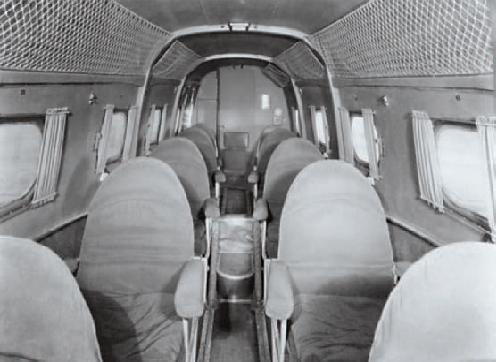
Boeing 247, 1933
In December 2008, an airplane crashed while taking off, ending up on fire in a 40 foot deep ravine several hundred yards from the runway. There were no fatalities among the 115 passengers and crew, even though the metal fuselage had been breached by fire. 
In December 2009, an airplane carrying 154 passengers and crew overran the runway during a landing in heavy rain and broke apart. There were no fatalities. accidents involving the current generation of commercial airplanes are rare but offer important insights into advancements in the safety and crashworthiness of airplane design. These advancements reflect decades of innovation and targeted efforts to improve survivability in an airplane accident, especially during takeoffs and landings. 
Boeing 707, 1958
in august 2010, an airplane crashed while attempting to land during poor weather, breaking into three pieces on impact. There were 125 survivors among the 127 passengers and crew aboard the flight. The industry’s work on airplane safety and survivability of airplane interiors emphasizes three areas: surviving impact, surviving a fire, and evacuation.

Surviving Impact

Survivability is greatly influenced by seat design. The greater the ability of airplane seats to remain in place and absorb energy during an impact, the greater the likelihood of passenger survival. in addition, the seat back is designed to protect passengers behind the seat from head injury. Seat design. in the 1930s, passenger airplane seats could withstand a static force six times the force of gravity (6g). For commercial jet airplanes beginning in the 1950s, the 6g requirement was raised to 9g. Today’s seats are required to withstand a 16g dynamic force. a 16g seat is tested in a manner that simulates the loads that could be expected in an impactsurvivable accident. 

Boeing 787, 2001
Two separate dynamic tests are conducted to simulate two different accident scenarios: one in which the forces are predominantly in the vertical downward direction and one in which the forces are predominantly in the longitudinal forward direction. The highest load factor is in the forward direction at a force of 16g. Head injury protection. Where head contact with seats or other structure can occur, boeing provides protection so that the head impact does not exceed the Head Injury Criterion (HIC) established by the u.S. Federal aviation administration (FAA). HIC measures the likelihood of head injury resulting from an impact. compliance with the Hic limit is demonstrated during a dynamic sled test that includes a 50 percent male size test dummy, the seat, and any airplane structure that could be impacted by the occupant’s head. 

Surviving a fire

Floor proximity lighting under dark conditions
In 1985, the FAA developed a new test standard for large surface area panels, such as ceilings, walls, overhead bins, and partitions. The standard required that all commercial airplanes produced after august 20, 1988, utilize panels that exhibit reduced heat and smoke emissions, delaying the onset of a flashover (i.e., the simultaneous or near simultaneous ignition of all flammable material in an enclosed area). interiors are updated and refurbished many times during the life of an airplane. This results in interiors that incorporate these enhancements even in older airplanes. in addition, airplanes manufactured on or after august 20, 1990, must comply with definitive standards of a maximum peak heat release rate of 65 kilowatts per square meter, a maximum total heat release of 65 kilowatt minutes per square meter, and specific optical smoke density of 200 (i.e., the OSu 65/65/200 fire safety standard defined by Ohio State university). extensive fire protection systems are also part of every Boeing passenger airplane. These systems include the use of fire protective materials, smoke detection and fire extinguishing systems, and insulation blankets designed to resist burn through from a fuel fire next to the bottom half of the fuselage. 

Evacuating the Airplane


Floor proximity lighting under smoky conditions
The FAA requires that an airplane can be evacuated of all passengers in 90 seconds. Boeing airplane interiors include a number of features to facilitate this process. These features include floor proximity lighting and escape slides. Floor proximity lighting. When passengers evacuate after a crash, buoyant hot smoke and gases can fill the cabin down to near floor level, obscuring overhead lighting. evacuation is improved through the use of lights, reflectors, or other devices to mark the emergency escape path along the floor. The Faa determined that floor lighting could improve the evacuation rate by 20 percent under certain conditions. as a result, the U.S. commercial fleet was retrofitted with floor proximity lighting by 1986, marking the completion of a two year compliance schedule. The 777 was the first Boeing airplane to include floor proximity lighting in production models.


12/08/2011

ALITALIA CITYLINER

Alitalia CityLiner
Alitalia is updating its fleet and on Sept. 26th the airline received its first Embraer 190, for its regional division . The carrier ordered twenty E-Jets, five E190 and 15 E175, at a total cost of 400 million Euro, that will replace the current regional fleet of ten CRJ900 of Air One and six E170 are already in service on the Rome-Milan route and on the Rome-Vienna and Rome-Trieste, they are equipped with "step approach" technology to operate on shorts field such as Florence and LCA.

The regional segment f the company keeps name Alitalia CityLiner that was of Air One. The choice of the E-Jet was a difficult one, based on three parameters, the judgment of customers, the opinions of employees and the overall economic data, and they will be flown on more services than mere feeder routes. 
Strategic cooperation was established with the manufacturer, that provides advanced technology and very reliable delivery and post sale service. The E190 is configured with 100 single class seats of late generation, with 30_31 in. pitch, with an enhanced perception of space.


These airlines will be used both on point_to_point national and international routes, and as an alternate on non-peak hours flights on multi-frequency routes have a strong component of business flyers, who require different option of time, for which flexibility is necessary.
Thus the passengers who fly the E190 on non-peak hours will enjoy the same advanced technology and the same high level of comfort as on the Airbus A320 family.
The current bases of Alitalia CityLiner are Milan Linate and Rome Fiumicino, and Venice will soon be added. Turin and Naples are also of much interest.
For connections with airliners of less than 80 seats, Alitalia will keep relying on strategic partnerships with specialized companies that can manage aircraft with haigt cost. The current partners of Alitalia are Darwin Airline and Air Alps, but more partnerships are begin considered. Alitalia wants to operate on smaller airfield both with direct capacity and through partners. Small but distant airports, such a Crotone or Trieste, can be addressed with direct capacity. The carrier stresses  the interest  for smaller destinations, and the fact that with its new regional fleet, Alitalia is able to better connect the Italian territory, reaching those minors airports where it was absent in the pas.

11/14/2011

Jet-biofuel: is real bio?


Aviation biofuel is widely considered by the aviation industry to be one of the primary means by which the industry can reduce its carbon footprint.


Aviation biofuel is widely considered by the aviation industry to be one of the primary means by which the industry can reduce its carbon footprint. After a multi-year technical review from aircraft makers, engine manufacturers and oil companies, biofuels were approved for commercial use in July of 2011. Since then, multiple airlines have begun the use of biofuels on commercial flights . 
The International Air Transport Association (IATA) thinks a 6% share of sustainable 2nd generation biofuels is achievable by 2020 and Boeing supports a target of 1% of global aviation fuels by 2015. This is in support of the goals of the aviation industry reaching carbon neutral growth by 2020 and a 50% decrease in carbon emissions by 2050 .


The American Section of the International Association for Testing Materials (ASTM) approve the use of biofuels in July of 2011. This allows the airlines to fly passenger jets using derivatives of up to 50 percent biofuel made from feedstocks such as algae and wood chips. It will help carriers that account for 2 percent of global carbon dioxide emissions reduce pollution blamed for damaging the Earth’s atmosphere. Jet fuel is a mixture of a large number of different hydrocarbons. The range of their sizes is restricted by the requirements for the product, for example, freezing point or smoke point. Jet fuels are sometimes classified as kerosene or naphtha-type. Kerosene-type fuels include Jet A, Jet A-1, JP-5 and JP-8. Naphtha-type jet fuels, sometimes referred to as "wide-cut" jet fuel, include Jet B and JP-4. "Drop-in" biofuels are biofuels that are completely interchangeable with conventional fuels. Deriving "drop-in" jet fuel from bio-based sources is ASTM approved via two routes.


The first route is bio-SPK (Bio derived synthetic paraffinic Kerosene). Bio-SPK involves using oil which is extracted from plant sources like jatropha, algae, tallows, other waste oils, Babassu and camelina to produce bio-SPK by cracking and hydro-processing. The growing of algae to make jet fuel is a promising but still emerging technology. Algae fuel uses algae as its source of natural deposits. Harvested algae, like fossil fuel, release CO2 when burnt but unlike fossil fuel the CO2 is taken out of the atmosphere by the growing algae. Among algal fuels' attractive characteristics: they do not affect fresh water resources, can be produced using ocean and waste water, and are biodegradable and relatively harmless to the environment if spilled. Algae cost more per unit mass (as of 2010, food grade algae costs ~$5000/tonne), due to high capital and operating costs, yet are claimed to yield between 10 and 100 times more energy per unit area than other second-generation biofuel crops. One biofuels company has claimed that algae can produce more oil in an area the size of a two car garage than a football field of soybeans, because almost the entire algal organism can use sunlight to produce lipids, or oil. The United States Department of Energy estimates that if algae fuel replaced all the petroleum fuel in the United States, it would require 15,000 square miles (39,000 km2) which is only 0.42% of the U.S. map. This is less than 1⁄7 the area of corn harvested in the United States in 2000. However, these claims remain unrealized, commercially. According to the head of the Algal Biomass Organization algae fuel can reach price parity with oil in 2018 if granted production tax credits.


The second route is FT SPK (Fischer–Tropsch Synthetic Paraffinic Kerosene). This process involves processing solid biomass using pyrolysis to produce pyrolysis oil or gassification to produce a syngas which is then prossessed into FT SPK. Jet fuel from the Fischer–Tropsch process using natural gas and coal. Using natural gas as a feedstock, the ultra-clean, low sulfur fuel has been tested extensively by the U.S. Department of Energy and the U.S. Department of Transportation. The Air Force, which is the U.S. military's largest user of fuel, began exploring alternative fuel sources in 1999. On December 15, 2006, a B-52 took off from Edwards AFB, California for the first time powered solely by a 50–50 blend of JP-8 and FT fuel. The seven-hour flight test was considered a success. The goal of the flight test program is to qualify the fuel blend for fleet use on the service's B-52s, and then flight test and qualification on other aircraft. The test program concluded in 2007. This program is part of the Department of Defense Assured Fuel Initiative, an effort to develop secure domestic sources for the military energy needs. The Pentagon hopes to reduce its use of crude oil from foreign producers and obtain about half of its aviation fuel from alternative sources by 2016. With the B-52 now approved to use the FT blend, the C-17 Globemaster III, the B-1B, and eventually every airframe in its inventory to use the fuel by 2011. 


But just because the prefix “bio-” is tacked on the word “fuel” doesn't necessarily mean it creates less pollution. Conventional fossil fuels sometimes result in less overall carbon dioxide emissions than biofuels, points out a Massachusetts Institute of Technology study recently published online in the journal Environmental Science and Technology. As we know, many airlines, have started using blends of conventional jet fuel with fuel produced from plants. The biofuels can help the companies cut costs, but are they really better for the environment? Only if the plants they come from are grown in ecologically sensitive ways, says James Hileman, principal research engineer in the department of aeronautics and astronautics at MIT. "What we found was that technologies that look very promising could also result in high emissions, if done improperly," reports Hileman in an MIT press release. "You can't simply say a biofuel is good or bad ‚ it depends on how it's produced and processed, and that's part of the debate that hasn't been brought forward, says Hileman.

Hileman and MIT graduate students Russell Stratton and Hsin Min Wong examined the carbon dioxide produced during the life cycle of 14 fuel sources, including conventional petroleum-based jet fuel and "drop-in" biofuels: alternatives that can directly replace conventional fuels with little or no change to existing infrastructure or vehicles. Growing crops for jet fuel production often entails clearing forests or using machines that also burn fuel. Drilling for oil takes energy, too. Then the raw materials from both sources have to be transported and processed. "All those processes require energy," Hileman says, "and that ends up in the release of carbon dioxide.  People don't often think of coal-to-liquid fuel production as a green option, remarks Hileman. But "severe cases of land-use change could make coal-to-liquid fuels look green," he says. On the other hand, the study points out many forms of biofuel that are more environmentally sensitive and produce less pollution. Many of these truly “green” biofuels have common characteristics. They can grow on marginal lands and don't compete with food for prime fertile land, and they also create useful by-products. Hileman notes that many of these by-products can further reduce the overall carbon dioxide release from the biofuels.


For example, converting jatropha, a shrub that can grow in poor soils and dry areas, to biofuel also yields solid biomass: For every kilogram (2.2 pounds) of jatropha oil produced, 0.8 kilograms (1.8 pounds) of meal, 1.1 kilograms (2.4 pounds) of shells and 1.7 kilograms (3.7 pounds) of husks are created. These by-products can be used to improve soil, prevent erosion or feed animals, or be burned for heat or electricity production.

All in all, the transition to biofuels is a complicated subject. Hileman notes that this research is only one lens through which biofuels can be viewed. The costs involved and crop yields are important considerations as well.


11/07/2011

Airbus and Boeing: a rivalry began 40 years ago, when one was David and the other Goliath (Part 3)


Forty years ago, the world was abuzz over the Boeing 747 and the BAC-Aerospatiale Concorde both whom had just made their first flights just a few months before. Within months of the 1969 Paris Air show the European aerospace companies created Airbus Industries which would take on the industry leaders of the day Boeing, Lockheed, and McDonnell Douglas. Today Airbus and Boeing are the two survivors battling it out in an intense global duopoly.

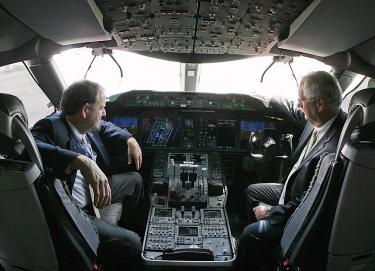
The Boeing 787 Dreamliner is a long-range, mid-size wide-body, twin-engine jet airliner developed by Boeing Commercial Airplanes. It seats 210 to 290 passengers, depending on the variant. Boeing states that it is the company's most fuel-efficient airliner and the world's first major airliner to use composite materials for most of its construction. The 787 consumes 20% less fuel than the similarly-sized Boeing 767. Some of its distinguishing features include a four-panel windshield, noise-reducing chevrons on its engine nacelles, and a smoother nose contour. The 787 also features a state of the art cockpit and passenger cabin. Boeing even offers its own version of the famous Airbus cabin "mood lighting".

As for the A 380, the 787 development and production has involved a large-scale collaboration with numerous suppliers around the globe. Final assembly is at the Boeing Everett Factory in Everett, Washington. The aircraft's initial designation was 7E7, prior to its renaming in January 2005. The first 787 was unveiled in a roll-out ceremony on July 8, 2007, at Boeing's Everett assembly factory, Originally planned to enter service in May 2008, the project has suffered from multiple delays.
While Boeing had been working to trim excess weight since assembly of the first airframe began, common for new aircraft in development, the company stated in December 2006 that the first six 787s were overweight, with the first aircraft expected to be 5,000 lb (2,300 kg) heavier than specified. According to International Lease Finance Corporation's (ILFC), the 787-9's operating empty weight was around 14,000 lb (6,400 kg) overweight. The seventh and subsequent aircraft would be the first optimized 787-8s and were expected to meet all goals, with Boeing working on weight reductions. As part of this process, Boeing redesigned some parts and made more use of lighter titanium.

Boeing had originally planned for a first flight by the end of August 2007 and premiered the first 787 at a roll out ceremony on July 8, 2007, which matches the aircraft's designation in the US-style month-day-year format (7/8/07).
On September 5, Boeing announced a three-month delay, blaming a shortage of fasteners as well as incomplete software. On October 10, 2007, a second three-month delay to the first flight and a six-month delay to first deliveries was announced due to problems with the foreign and domestic supply chain, including an ongoing fastener shortage, the lack of documentation from overseas suppliers, and continuing delays with the flight guidance software. Less than a week later, Mike Bair, the 787 program manager was replaced. On January 16, 2008, Boeing announced a third three-month delay to the first flight of the 787, citing insufficient progress on "traveled work".

On April 9, 2008, Boeing officially announced a fourth delay, shifting the maiden flight to the fourth quarter of 2008, and delaying initial deliveries by around 15 months to the third quarter of 2009. The 787-9 variant was postponed to 2012 and the 787-3 variant was to follow with no firm delivery date. On November 4, 2008, the company announced a fifth delay due to incorrect fastener installation and the Boeing machinists strike, stating that the first test flight would not occur in the fourth quarter of 2008. After assessing the 787 program schedule with its suppliers, Boeing confirmed on December 11, 2008 that the first flight would be delayed until the second quarter of 2009.
Boeing featured its first 787 in a roll-out ceremony on July 8, 2007, at its Everett assembly factory, by which time it had become the fastest-selling wide-body airliner in history with nearly 600 orders. A total of 861 Boeing 787s have been ordered by 56 customers as of April 2009.
On December 15, 2009, Boeing conducted the Dreamliner's maiden flight with the first 787-8, originating from Snohomish County Airport in Everett, Washington and landing at Boeing Field in King County, Washington Completed flight testing in mid-2011. Final Federal Aviation Administration and European Aviation Safety Agency certification was received in late August 2011 and the first model was delivered in September 26 2011. and the first commercial flight was in October 26

After initially claiming the A330 would be able to compete with the 787 Dreamliner, the massive success of the 787 prompted Airbus to develop and announce the A350XWB (eXtra Wide Body) which will become more of a competitor to the Boeing 777 as well as some models of the Boeing 787. The A350XWB cabin is 13 cm (5.1 in) wider at eye level than the competing Boeing 787, and 28 cm (11 in) narrower than the Boeing 777, and all A350 passenger models will have a range of at least 8,000 NM (15,000 km). Like the Boeing 787, the A350XWB will make extensive use of composite materials in place of the traditional aluminum, and have a state of the art cockpit. The fuselage will be of parallel cross-section from Door 1 to Door 4 thus providing for maximum volume in the passenger cabin. The plane has till date logged 483 orders and is currently under development and scheduled to enter service in 2013, about the same time the 787-9 variant of the Dreamliner will.

Now the challenge will move on the single-aisle aircraft, with the A320neo and the 737MAX, and so the rivalry and one-upmanship carries on. But there will be time to talk about this.

11/04/2011

Boeing announces design changes for 737 MAX


Boeing has announced which will the engine for the 737MAX


The company released the new details Thursday to try to stem the momentum of the hot selling A320neo, Airbus' revamp of its single-aisle jet family that features an even larger new engine that will produce the most fuel-efficient and least-costly jet in the single-aisle market.
The current models of the Airbus A320 and the Boeing 737 split the single-aisle market roughly down the middle. Boeing needs the MAX to maintain that share against the neo. The 737 chief project engineer, said the current 737 is lighter and more fuel efficient than the current A320, and the new MAX design will leapfrog the neo and have 7 percent better operating economics. The engine for the 737 MAX will have a larger, 68-inch diameter fan and a lower weight affects about 30 percent of its operating costs, and more efficient, lighter design and requires less thrust than other airplanes in this class, which is important because weight and thrust have a significant effect on fuel efficiency and operating costs. Airbus decided two years ago to add a new engine to its A320 single-aisle jet and received hundreds of firm orders at this year's air show. Boeing followed suit and said Thursday that it now has 600 commitments for the new MAX, up from 496 when it launched the program in August.
John Hamilton, the 737 chief project engineer, said:"There's a much better structural efficiency that goes into the 737 design than into the Airbus design," Boeing will increase the engine fan size from 61 inches on today's 737 to 68 inches on the new MAX engine — called the LEAP, being developed by CFM International. A bigger fan sucks in more air, providing greater thrust. But Boeing's increase in engine fan size just matches the fan size of today's A320.
"Today, our (737) engine is 7 inches smaller than the Airbus (A320) engine, and yet we have lower operating costs," Hamilton said. "The 737-900ER is nearly 50 pounds lighter per seat" than the comparable A321. The MAX "doesn't need the high thrust requirements that the Airbus product has," he said. "When you look at drag, fuel efficiency and weight, the 68-inch fan is really the optimum solution for the 737 airplane going forward." It said in one year, a fleet of 100 will save 175 million pounds of jet fuel and save $85 million in fuel costs. Boeing said the amount of fuel burned should be 16 percent less than the competitors are burning now and 4 percent less than future offerings.
Airbus spokeswoman Mary Anne Greczyn dismissed that claim, saying Boeing is struggling to overcome a structural limitation: that the 737 wing sits closer to the ground than the A320's wing, so that a larger, more fuel-efficient fan won't fit. "If a smaller fan engine were to generate the appropriate level of efficiency, we could have easily incorporated that, since we are not constrained as our competitor, " Greczyn said. "The A320neo family is designed to benefit from the aircraft's inherent advantage." He acknowledged that Boeing is behind Airbus in its re-engine program, the A320neo, but said there's a lot of interest from airlines in Boeing's model. "It's a huge growth market," he said of single-aisle jets. "The customers are responding quite well, and we expect several hundred more commitments soon."
Hamilton said the engine will be the largest change for the 737 MAX, but he noted several smaller ones. Boeing will refine the 737 airframe design in relatively small ways without changing the overall size of the planes. The larger, heavier engine will necessitate strengthening of the wing and parts of the fuselage, as well as designing a heftier strut to hold the engine on the wing and making minor system changes. Boeing will also lengthen the nose landing gear to raise the wing slightly and reshape the tail cone to streamline the air flow. and it will introduce fly-by-wire spoilers — the hinged parts on the wing that rise on landing to increase drag — which means they will be operated by computer rather than by direct cable connections.
Boeing said Thursday it continues to work with customers to see what they want in a new model aircraft. Boeing launched the 737 MAX in August; Airbus launched the neo last December and by the summer had captured more than 1,000 orders from airlines eager for more fuel-efficient planes.


Hamilton said customers are "responding well" to Boeing's preliminary design and that he expects "several hundred more commitments soon." Boeing won't finalize the design until 2013, he said.
The neo, due to enter service in 2015, at the end of September had 918 firm orders plus an additional 319 purchase commitments. The MAX, scheduled to enter service in 2017, has no firm orders. But on Thursday Boeing said it has garnered 600 purchase commitments from eight airlines, including some U.S. carriers.
Hamiliton called the 737 the most popular and reliable commercial jet and said it has sold more than 9,000 of the Renton-built aircraft.
Boeing has not announced where it will build the new 737 model, although analysts say it would be difficult for it to meet its deadlines if it tries to build entirely new production facilities elsewhere. Boeing executives say they will decide by the spring. Company spokeswoman Karen Crabtree said Thursday that the Renton site "has the skill base and knowledge to incorporate the production changes" needed for the MAX.

Airbus and Boeing: a rivalry began 40 years ago, when one was David and the other Goliath (Part 2)


Forty years ago, the world was abuzz over the Boeing 747 and the BAC-Aerospatiale Concorde both whom had just made their first flights just a few months before. Within months of the 1969 Paris Air show the European aerospace companies created Airbus Industries which would take on the industry leaders of the day Boeing, Lockheed, and McDonnell Douglas. Today Airbus and Boeing are the two survivors battling it out in an intense global duopoly.

On 19 December 2000, Airbus decided to end the three decade old monopoly of the Boeing 747 jumbo jet and formally launched the largest passenger aircraft in the world, the Airbus A380 super jumbo. The megaproject was announced at the 1990 Farnborough Air Show, with the stated goal of 15% lower operating costs than the 747-400. Airbus organized four teams of designers, one from each of its partners (AƩrospatiale, Deutsche Aerospace AG, British Aerospace, CASA) to propose new technologies for its future aircraft designs. The A380's upper deck extends along the entire length of the fuselage, which allows for a cabin with 50% more floor space than the next-largest airliner, the Boeing 747-400 and provides seating for 525 people in standard three-class configuration or up to 853 people in all economy class configurations. Most airlines have outfitted their A380s with luxurious first class private suites, one even offering on-board showers.
The first A380, serial number MSN001 and registration F-WWOW, was unveiled at a ceremony in Toulouse on January 18, 2005.
But initial production of the A380 was troubled by delays. Airbus cited as underlying causes the complexity of the cabin wiring , its concurrent design and production, the high degree of customization for each airline, and failures of configuration management and change control.
Airbus announced the first delay in June 2005 and notified airlines that deliveries would be delayed by six months. His reduced the total number of planned deliveries by the end of 2009 from about 120 to 90–100. On 13 June 2006, Airbus announced a second delay, with the delivery schedule undergoing an additional shift of six to seven months. Although the first delivery was still planned before the end of 2006, deliveries in 2007 would drop to only 9 aircraft, and deliveries by the end of 2009 would be cut to 70–80 aircraft. On 3 October 2006, upon completion of a review of the A380 program, the CEO of Airbus, Christian Streiff, announced a third delay, pushing the first delivery to October 2007, to be followed by 13 deliveries in 2008, 25 in 2009, and the full production rate of 45 aircraft per year in 2010.

As Airbus prioritized the work on the A380-800 over the A380-800F, freighter orders were canceled by FedEx and UPS, or converted to A380-800 by Emirates and ILFC. Airbus suspended work on the freighter version, but said it remained on offer, albeit without a service entry date. For the passenger version Airbus negotiated a revised delivery schedule and compensation with the 13 customers, all of which retained their orders with some placing subsequent orders, including Emirates, Singapore Airlines, Qantas, Air France,Qatar Airways, and Korean Air. The first aircraft, as delivered to Singapore Airlines on 15 October 2007 and entered service on 25 October 2007 Two months later, Singapore Airlines CEO Chew Choong Seng said that the A380 was performing better than both the airline and Airbus had anticipated, burning 20% less fuel per passenger than the airline's existing 747–400 fleet.

Boeing didn't want to lose a VLA (Very Large Aircraft) monopoly, and at the same time develops the Boeing 747-8 Intercontinental (to compete with the A380) the fourth-generation Boeing 747 version, with lengthened fuselage, redesigned wings and improved efficiency, and the Boeing 787 Dreamliner. Perhaps the effort to develop two programs at the same time has caused delays.
Boeing had considered larger-capacity versions of the 747 several times during the 1990s and 2000s.In the 1996 Farnborough Airshow, announced would have stretched the 747 and used a 777-derived wing, but did not attract enough interest to enter development. In 2000, Boeing offered the 747X and 747X Stretch derivatives as alternatives to the Airbus A3XX. This was a more modest proposal than the previous . The 747X would increase the 747's wingspan to 229 ft (69.8 m) by adding a segment at the root. The 747X was to carry 430 passengers up to 8,700 nmi (16,100 km). The 747X Stretch would be extended to 263 ft (80.2 m) long, allowing it to carry 500 passengers up to 7,800 nmi (14,400 km). However, the 747X family was unable to attract enough interest to enter production. Some of the ideas developed for the 747X were used on the 747-400ER.

After the 747X program, Boeing continued to study improvements to the 747. The 747-400XQLR (Quiet Long Range) was meant to have an increased range, with better fuel efficiency and reduced noise. Changes studied included raked wingtips similar to those used on the 767-400ER and a sawtooth engine nacelle for noise reduction. Although the 747-400XQLR did not move to production, many of its features were used for the 747 Advanced.
In early 2004, Boeing announced tentative plans for the 747 Advanced that were eventually adopted. Similar in nature to the 747X, the stretched 747 Advanced used technology from the Boeing 787 Dreamliner to modernize the design and its systems. On November 14, 2005, Boeing announced that it was launching the 747 Advanced as the "Boeing 747-8. 
The 747-8 was intended to use the same engine and cockpit technology as that of the 787, including the General Electric GEnx turbofan and partial fly-by-wire. Boeing said that the new design would be quieter, more economical, and more environmentally friendly than previous versions of the 747. As a derivative of the already-common 747-400, the 747-8 has the economic benefit of similar training and interchangeable parts. Boeing claims that the 747-8 is more than 10 percent lighter per seat and will consume 11 percent less fuel per passenger than the A380, translating into a trip-cost reduction of 21 percent and a seat-mile cost reduction of over 6 percent

Production of the first 747-8 Freighter began in Everett in early August 2008. On November 14, 2008, Boeing announced a delay to the 747-8 program, citing limited availability of engineering resources within Boeing, design changes, and the recent strike by factory workers. On July 21, 2009, Boeing released a photograph of the first cargo airplane, its fuselage and main wing assembled.
In February 2009, only one airline customer (Lufthansa) had ordered the 747-8I passenger model, and Boeing announced it was reassessing the 747-8 project. Chief executive Jim McNerney stated that continuation of the project was not a foregone conclusion. The company was assessing various options.
In October 2009, Boeing announced that it had delayed the first flight on the 747-8 until first quarter 2010 and delayed 747-8I delivery. In response, launch customer Cargolux stated it still intended to take delivery of the thirteen freighters it had ordered; Lufthansa confirmed its commitment to the passenger version. On November 12, 2009, Boeing announced that Cargolux's first airplane was fully assembled and entering the Everett plant's paint shop. It will undergo flight testing prior to delivery.
On February 8, 2010, after a 2.5-hour weather delay, the 747-8 Freighter made its maiden flight, taking off from Paine Field, Washington. On March 17 the third -8F made its first flight and joined the test program. Boeing still plans to display the 747-8F at the 2010 Farnborough Airshow, along with the 787, although appearances by both aircraft are contingent on flight testing remaining on schedule. During the flight tests, Boeing discovered a buffet problem with the aircraft, involving turbulence coming off the landing gear doors interfering with the inboard flaps. Boeing undertook an evaluation of the issue, which included devoting the third test aircraft to investigating the problem. The issue was resolved by a design change to the outboard main landing gear doors. In early April 2010, Boeing identified a possible defect in a part at the top of the fuselage called a longeron. According to Boeing, the parts, manufactured by subcontractor Vought Aircraft Industries, are, under certain loads, susceptible to cracking. Boeing said that the issue would not affect flight testing, but other sources stated that the problem could impact the operating envelope of the aircraft until it is fully repaired. Two other problems have been found, with oscillation in the inboard aileron, and a structural flutter, and have not yet been resolved. Combined, these problems have slowed flight testing and used up almost all the margin in Boeing's development schedule. 

On September 17, 2011 Cargolux announced that it would not accept the first two 747-8Fs due to "unresolved contractual issues between Boeing and Cargolux" with the aircraft. The 747-8F's first commercial flight was planned for September 26, 2011 by Cargolux from Luxembourg. After resolving their contractual issues, Boeing handed over the first 747-8F to Cargolux in Everett, Washington on October 12, 2011. The freighter then flew to Seattle–Tacoma International Airport and picked up cargo before flying to Luxembourg.